
Opening Introduction
Leo is looking for his kitten, Misty. He looks under the bed. He looks behind the curtain. He looks on the chair. "Where are you, Misty?" he calls. Then, he hears a soft meow. He looks up. Misty is in the box! "You are in the box!" Leo laughs. His mom smiles. "You used special words to look for Misty. Under, behind, on, in. These words tell us where things are. They are called prepositions of place. And the best way to learn them is with pictures. Let's explore prepositions of place with pictures and become location detectives!" Leo likes the idea. He loves pictures and he loves finding things. Let's start our search.
Core Knowledge Explanation
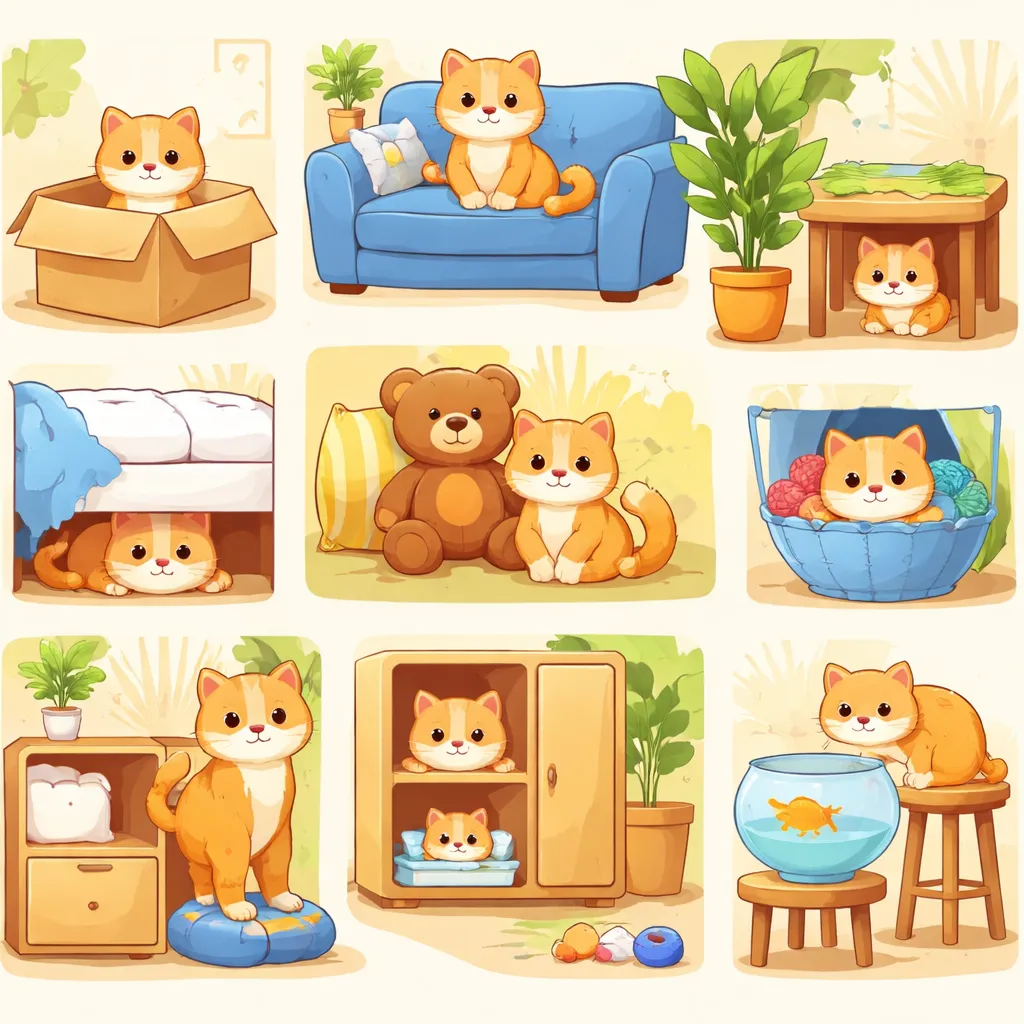
What is a preposition? A preposition is a small word that shows the relationship between things. A preposition of place tells us where something is. It answers the question "Where?" Words like in, on, under, next to, behind, in front of, between. These words are like a map for your sentences. They help you describe exactly where to find something. Learning prepositions of place with pictures is the easiest way. When you see a picture, you can see the cat is on the table. The word "on" makes sense because you see it.
Let's look at some main prepositions. The first one is IN. IN means inside something. A fish is in the water. Toys are in the box. You are in your house. The second is ON. ON means touching the top surface of something. The book is on the table. The picture is on the wall. The third is UNDER. UNDER means below something. The ball rolled under the sofa. The shoes are under the bed. The fourth is NEXT TO. NEXT TO means beside something. The green car is next to the red car. My house is next to the park.
Now, let's look at more. BEHIND means at the back of something. The boy is hiding behind the tree. IN FRONT OF means the opposite. The car is in front of the house. BETWEEN means in the middle of two things. The blue ball is between the red ball and the yellow ball. ABOVE means higher than something. The plane flies above the clouds. BELOW means lower than something. The roots are below the ground. These are the basic prepositions of place with pictures. When you see a drawing of a cat and a table, you can say "The cat is under the table" or "on the table". The picture makes the word clear. It is like a game of matching the word to the scene.
Fun Interactive Learning
Let's play a picture game. It is called "Draw the Preposition." Get a piece of paper. Draw a big tree in the middle. Now, listen and draw. "Draw a bird ON the tree branch." "Draw a squirrel UNDER the tree." "Draw a flower NEXT TO the tree." "Draw a sun ABOVE the tree." Now, you have a picture that shows many prepositions of place with pictures. Label your drawing with the prepositions. This is fun and creative.
Another game is "Preposition Scavenger Hunt." Make a list of prepositions: in, on, under, next to. Walk around your room. Find an example for each one. "I see a pencil IN the cup." Take a photo or draw a quick picture. Make a little book of your finds. This turns your room into a learning adventure. You are finding prepositions of place with pictures in your own world.
You can also play "Simon Says" with prepositions. "Simon says, put your hands ON your head." "Simon says, stand NEXT TO the table." "Put the book UNDER the chair." But only if Simon says! This gets your whole body moving and understanding the words. These games make learning prepositions of place with pictures active and memorable.
Expanded Learning
Prepositions are in every language. In Spanish, "on" is "sobre". In French, "under" is "sous". The idea is the same, but the word is different. Long ago, people used gestures and pictures to show where things were. Today, we have words. But pictures are still a universal language. That is why learning prepositions of place with pictures is so powerful. Everyone can understand a picture.
Did you know that maps use prepositions? A city might be on a river. A park is between two streets. When you give directions, you use prepositions. "The library is next to the bank." So, prepositions help you navigate the real world. They are not just for grammar. They are for life. Let's make a chant about prepositions. Chants are fun and stick in your head.
Where, oh where, is the little mouse? Is he IN the house? Is he ON the chair? Is he UNDER the table, over there? Next to the box, or behind the door? These are prepositions, let's learn some more! With pictures and fun, we'll see the place, A big smile will light up your face!
What You Will Learn
You are learning about location and description. You are learning the main prepositions of place with pictures: in, on, under, next to, behind, in front of, between, above, below. You are also learning how to use them in sentences.
You are learning clear sentences. You can say, "The cookies are in the jar." You can describe, "The dog is sleeping under the tree." You can give directions, "Put the book on the shelf." You are using English to talk about position, which is very useful every day.
You are building important skills. You are building spatial awareness. You understand how objects relate to each other. You are building vocabulary. You learn precise words for location. You are building following instructions. You can understand and give directions. You are building observation skills. You notice where things are. You are building confidence. You can describe a scene accurately.
You are forming a precise habit. The habit of using the right word for the right place. This makes you a better communicator. Learning prepositions of place with pictures helps you in art, in sports, in reading maps, and in everyday life. It is a fundamental skill.
Using What You Learned in Life
Use prepositions every day. When you clean your room, say where things go. "The teddy bear goes on the bed." When you help in the kitchen, "The spoons go in the drawer." When you are playing with toys, set up a scene and describe it. "The castle is on the mountain. The knight is in front of the castle." When you read a picture book, point out the prepositions you see in the pictures.
At school, use prepositions in your writing. "I sat next to my friend." In art class, describe your picture. "I drew a bird above the house." When you are walking, practice. "We are walking past the park." The more you use prepositions of place with pictures in your mind and your speech, the more natural they will become. You will be a master of describing the world around you.
Closing Encouragement
You are a location detective. You are a word artist. You are a careful observer. I am so proud of you. Learning prepositions of place with pictures shows you have a sharp eye for detail.
Keep looking at the world and describing it. Every room, every street, every picture in a book is a chance to practice your new words. You are learning to see and describe the world with clarity.
You are smart, you are attentive, and you are becoming an expert in the language of where. Great work, my wonderful preposition explorer.