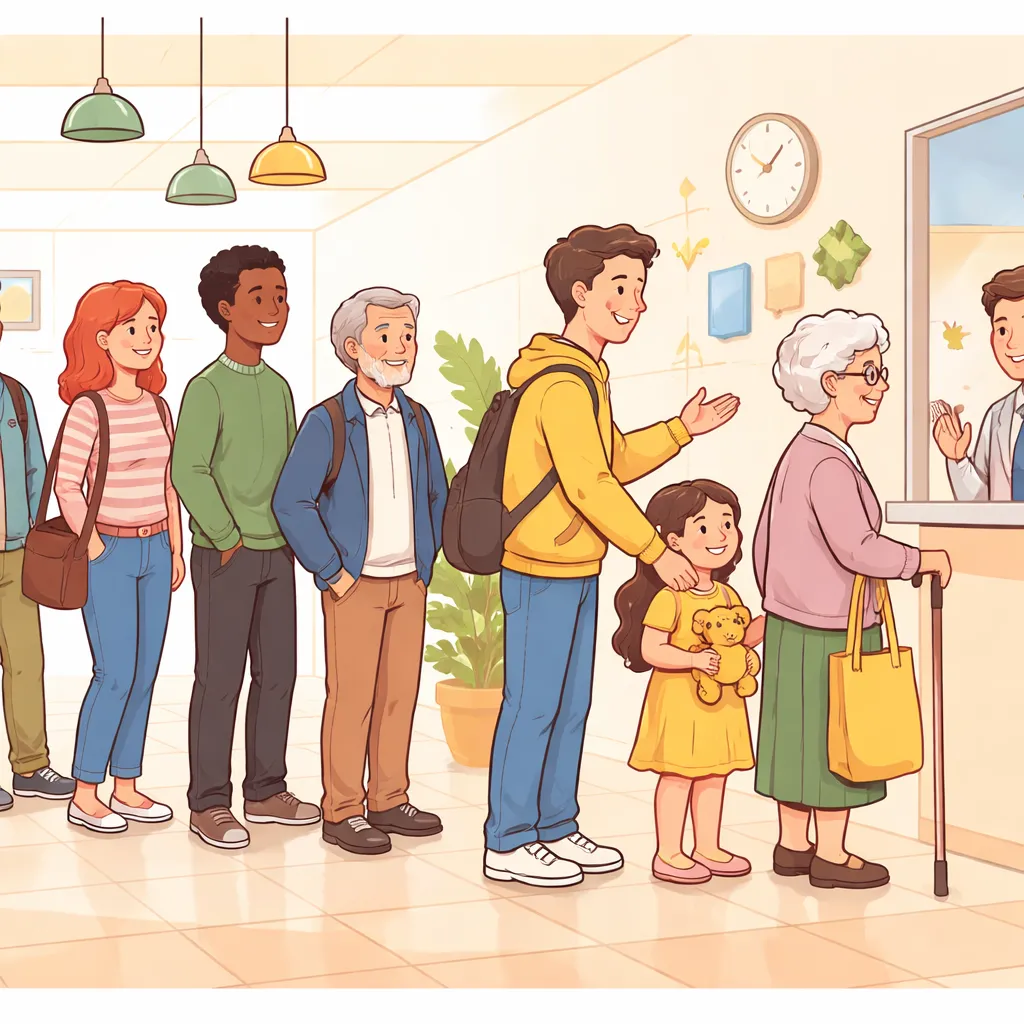

What Is This Situation? Waiting in line is something children do often. At the grocery store, at the playground slide, at school for lunch. A line means waiting for a turn. Waiting can be hard for young children. Their bodies want to move. Their minds want to go now.
English phrases for waiting in line give children the words to handle this challenge. They learn to ask how long. They learn to say what they are waiting for. They learn to express their feelings without acting out. The words help them wait.
This situation happens at stores, at school, at parks, at events. Anywhere people wait their turn. Lines are part of life. Learning to wait with words instead of whining is an important skill.
These phrases are simple and practical. They help children understand the situation. They give them ways to ask questions. They help them stay calm. With these words, waiting becomes something they can manage.
Key English Phrases for This Situation Use phrases for understanding the wait. "We are waiting in line" explains the situation. "Our turn is coming" gives hope. "We are next" shows progress.
Use phrases for asking about time. "How much longer?" asks for an estimate. "Is it our turn soon?" checks progress. "How many people are in front of us?" counts the wait.
Use phrases for expressing feelings. "Waiting is hard" names the challenge. "I am trying to be patient" shows effort. "I can wait" states ability.
Use phrases for staying calm. "Let us take a deep breath" calms the body. "Can you count to ten?" distracts the mind. "Look at the clouds" redirects attention.
Use phrases for when it is finally time. "It is our turn" announces the moment. "Now we go" signals action. "You waited so well" praises the effort.
Simple Conversations for Kids Dialogue 1: At the Grocery Store Child: "Why are we stopping?" Parent: "We are waiting in line. See all the people in front of us?" Child: "I want to go now." Parent: "I know waiting is hard. Let us count the people in front of us. One, two, three." Child: "Then it is our turn?" Parent: "Yes. We are fourth. Our turn is coming."
This conversation names the situation. The parent validates the feeling. The parent gives a way to measure the wait. Counting makes waiting concrete.
Dialogue 2: At the Playground Child: "I want to go down the slide." Parent: "There is a line. We have to wait our turn." Child: "But I want to go now." Parent: "Let us watch the children go down. One, two, three. Soon it will be your turn." Child watches. Parent: "You are waiting so well. Look, you are next."
This conversation uses observation to pass time. The parent helps the child watch the line move. The child sees progress. The parent praises the waiting.
Dialogue 3: A Long Wait Child: "How much longer?" Parent: "We have a few more minutes." Child: "I am tired of waiting." Parent: "Waiting is hard. Let us play a game. I spy something blue." Child looks around. "The car." Parent: "Yes. Now your turn." This game continues until the line moves.
This conversation uses a game to make waiting fun. The parent acknowledges the feeling. The parent offers a distraction. The child engages. The time passes.
Vocabulary You Should Know Line is when people stand one behind the other. You can say "We are in line." This word names the situation.
Wait means to stay in one place until something happens. You can say "We wait for our turn." This word names the action.
Turn means your chance to do something. You can say "It is my turn." This word names what you are waiting for.
Next means after this one. You can say "You are next." This word shows progress.
Patient means able to wait without getting upset. You can say "You are being patient." This word describes the goal.
Soon means in a short time. You can say "Our turn will come soon." This word gives hope.
How to Use These Phrases Naturally Use a calm and steady tone. Your voice sets the tone for waiting. If you sound frustrated, your child gets frustrated. If you sound calm, they learn to be calm.
Say the phrases before frustration builds. When you see your child getting restless, start the conversation early. "We are waiting in line. Let us count the people." Early intervention prevents meltdowns.
Use the same phrases each time. Consistency builds understanding. Your child learns that "our turn is coming" means the wait will end. Familiar words bring comfort.
Let your child ask questions. "How much longer?" is a good question. Answer honestly. "Three more people." Honesty builds trust. Your child learns to trust your answers.
Praise the waiting. "You waited so well" tells your child they did something good. Specific praise teaches what good waiting looks like.
Common Mistakes to Avoid One mistake is promising a time you cannot keep. "We will be next" when you are not next breaks trust. Be honest. "There are three people in front of us." Honesty is better than false hope.
Another mistake is getting frustrated yourself. Your child feels your frustration. Take a deep breath. Model calm waiting. Your child learns from you.
Some parents give in to avoid the wait. Leaving the line teaches that waiting is optional. Sometimes leaving is necessary. But when waiting is required, stay. Your child learns that waiting is part of life.
Avoid shaming impatience. "Stop whining" does not teach skills. Name the feeling. "I know you are tired of waiting." Then offer a strategy. "Let us play a game." Skills, not shame.
Tips for Parents and Practice Ideas Bring waiting tools. A small toy, a book, or a snack can make waiting easier. The tools distract. They also give you something to talk about.
Play waiting games. "I spy" is perfect. Counting games work. "How many red cars do you see?" Games pass time and build language.
Talk about what you see. "Look at that dog. What color is it?" Observation turns waiting into learning. Your child practices words while they wait.
Prepare your child before the wait. "We will have to wait in line at the store. Let us practice being patient." Knowing what to expect reduces anxiety.
Practice waiting at home. "Let us pretend we are waiting in line." Role-play the experience. Your child practices the words and the patience in a safe space.
Fun Practice Activities Create a waiting line with chairs. Line up chairs. Take turns being first. Use the phrases. "I am waiting in line. It is my turn. I waited so well."
Make a waiting game. Use small toys. Line them up. Move them forward one by one. "First, second, third, next." This visual helps children understand the concept of waiting in line.
Use a timer. Set a timer for one minute. Your child waits. When the timer beeps, they get a small reward. Gradually increase the time. This builds waiting skills.
Read books about waiting. Many children's books have characters who wait. Read them together. Talk about how the character felt and what they did.
Play line leader. Your child is the leader of the line. They say "Line up, please." They wait for everyone to be ready. This playful practice builds skills.
English phrases for waiting in line give children the tools to handle one of life's daily challenges. They learn that waiting has words. They learn that patience is a skill, not just something you have or do not have. With your calm presence and these simple phrases, your child learns to stand in line without falling apart. They learn to ask "How much longer?" and to hear "Soon." They learn that turns come. And they learn that they can wait. That is a lesson that serves them for life.