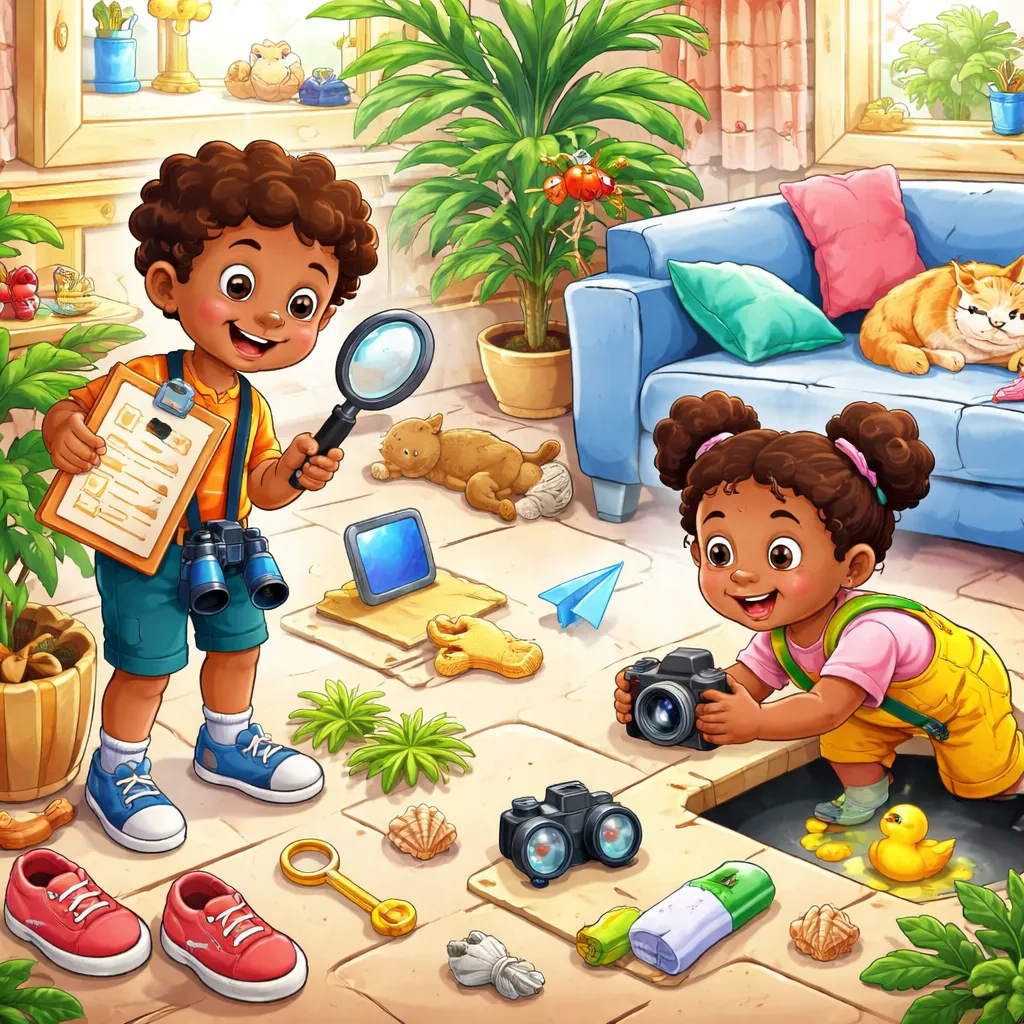

What Is This Situation? A scavenger hunt is a game where you find things. You have a list. You look around. You find each item. It is active. It is fun. And it is a powerful way to learn English. Children find objects. They learn the words. They use the words.
An English scavenger hunt list for home gives children a playful way to practice vocabulary. Find something red. Find something round. Find something that starts with B. The hunt builds listening, vocabulary, and observation skills.
This situation happens during playtime, during rainy days, during moments when children need to move. Scavenger hunts are active. They get children up and moving. Learning happens while playing.
These hunts are best used with conversation. Read the list. Talk about what you find. Celebrate each discovery. With scavenger hunts, your child learns English while exploring the home.
Key English Phrases for This Situation Use phrases for starting the hunt. "Let us go on a scavenger hunt. Here is the list. We need to find these things." "First, find something red. What is red in this room?"
Use phrases for searching. "Look around. Do you see something red? A red ball? A red book?" "Good. You found a red ball. Now find something round."
Use phrases for celebrating. "You found the red ball. Good job." "You found something round. A ball is round. Good."
Use phrases for reading the list. "The next thing is something that starts with B. Can you find something that starts with B?" "B is for book. You found a book. Good."
Use phrases for finishing. "You found everything on the list. You are a great hunter." "Let us do another hunt tomorrow."
Simple Conversations for Kids Dialogue 1: Color Hunt Parent: "Let us do a scavenger hunt. First, find something red." Child looks around. Child: "The ball is red." Parent: "Yes. The ball is red. Good. Now find something blue." Child: "The cup is blue." Parent: "Yes. You found blue. Good job."
This conversation starts the hunt. The parent gives directions. The child finds objects. The learning begins.
Dialogue 2: Shape Hunt Parent: "Now find something round." Child: "The plate is round." Parent: "Yes. The plate is round. Good. Now find something square." Child: "The block is square." Parent: "Yes. You found square. Good job."
This conversation continues the hunt. The child finds shapes. The parent confirms. The vocabulary grows.
Dialogue 3: Letter Hunt Parent: "Now find something that starts with B." Child: "Book starts with B." Parent: "Yes. Book. B-b-book. Good. Now find something that starts with C." Child: "Cat starts with C." Parent: "Yes. Cat. C-c-cat. You found all the things. Great job."
This conversation practices beginning sounds. The child finds objects. The parent praises. The skills build.
Vocabulary You Should Know Red is a color. You can say "Find something red." This is a color word.
Blue is a color. You can say "Find something blue." This is another color word.
Round is a shape. You can say "Find something round." This is a shape word.
Square is a shape. You can say "Find something square." This is another shape word.
Letter is a symbol. You can say "Find something that starts with B." This is a beginning sound word.
Object is a thing. You can say "Find an object that is red." This is what you are looking for.
How to Use These Phrases Naturally Use an excited and curious tone. Scavenger hunts are adventures. Your voice should show it. "Let us find something red. Where is it?"
Say the phrases as you hunt. "Find something red." Let your child lead. The words guide the game.
Let your child read the list. If they can read, let them. Reading the list is practice.
Celebrate each find. "You found the red ball. Good job." Celebration makes the game fun.
Do the hunt together. You find things too. "I found a blue cup." Modeling is powerful.
Common Mistakes to Avoid One mistake is making the list too long. Start with five things. Add more as your child gets older.
Another mistake is using words your child does not know. Use familiar words. Introduce new words slowly.
Some children want to do the same hunt again. That is good. Repetition builds mastery.
Avoid rushing. Let your child look. The looking is the learning. The finding is the reward.
Tips for Parents and Practice Ideas Make a list with pictures. For young children, draw the items. They can match the picture to the object.
Use the list for different rooms. A kitchen hunt. A bedroom hunt. A bathroom hunt. Variety keeps it interesting.
Time the hunt. "Can you find all the things in two minutes?" A timer adds excitement.
Let your child make the list. They choose what to find. Making the list is learning.
Take a picture of each find. Make a book of your scavenger hunts. The book is a memory and a learning tool.
Fun Practice Activities Play color scavenger hunt. Find something red, blue, yellow, green. The colors are the list.
Play shape scavenger hunt. Find something round, square, triangle, rectangle. The shapes are the list.
Play letter scavenger hunt. Find something that starts with A, B, C, D. The letters are the list.
Play texture scavenger hunt. Find something soft, hard, smooth, bumpy. The textures are the list.
Play number scavenger hunt. Find two of something. Three of something. Four of something. The numbers are the list.
An English scavenger hunt list for home turns your house into a language adventure. Find something red. Find something round. Find something that starts with B. With playful practice and patient guidance, your child will learn colors, shapes, letters, and words. They will explore their home. They will build vocabulary. They will have fun. That is the power of a scavenger hunt. One find at a time, your child will learn. And you will be there to hunt and celebrate together.