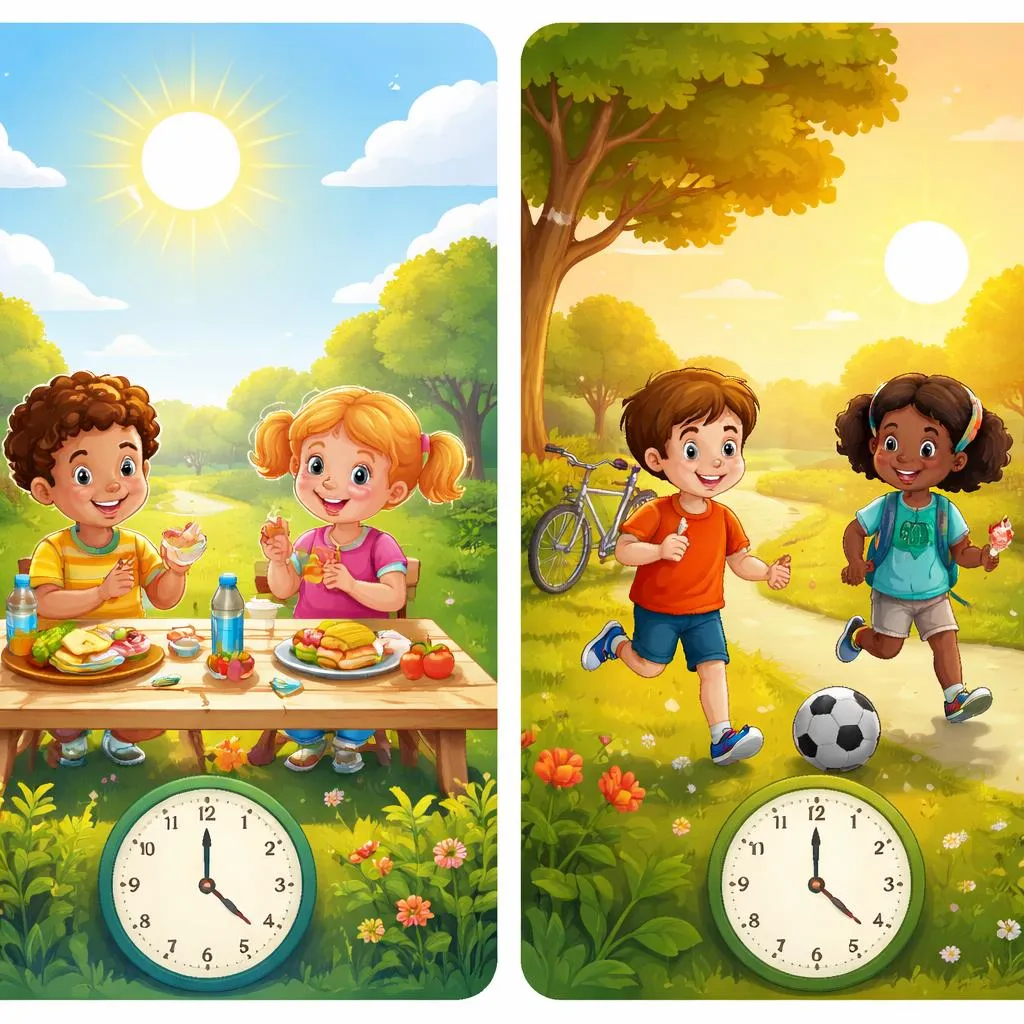

What Do These Expressions Mean? “It's afternoon” and “it's midday” both mean the time of day between morning and evening. They tell a child that the sun is past its highest point or in the middle of the day. Children hear these words around lunchtime or after school. Both describe the middle part of the day.
“It's afternoon” means the time from noon until evening. It is common and direct. A child says it when lunch is over. It is the everyday word.
“It's midday” means the exact middle of the day, around noon. It is more specific. A child says it when the sun is highest. It feels more precise.
These expressions seem similar. Both mean “not morning, not night.” Both describe the middle of the day. But one is a long period while one is a specific point.
What's the Difference? One is a long period. One is a specific point or short time around noon. “It's afternoon” covers from 12:00 PM until about 5:00 or 6:00 PM. It is a wide range. It is the standard word.
“It's midday” means the exact middle of the day, roughly 12:00 PM. It is a shorter time frame. It can also mean the period around noon. It is more specific and formal.
Think of a child eating lunch at 12:30 PM. “It's afternoon” is true. “It's midday” is also true, but refers more to the noon hour. One is a period. One is a point.
One is for general time. The other is for the precise middle. “Afternoon” for after lunch. “Midday” for high sun. Use the first for period. Use the second for precision.
Also, “midday” sounds more formal or scientific. “Afternoon” is everyday talk. Children learn “afternoon” first.
When Do We Use Each One? Use “it's afternoon” for the general period after noon. Use it for the hours after lunch until dinner. Use it for everyday conversation. It fits daily talk.
Examples at home: “It's afternoon. Time for a nap.” “I do my homework in the afternoon.” “Let’s go to the park this afternoon.”
Use “it's midday” for the exact noon hour or the highest sun. Use it for precision or science lessons. Use it for formal contexts. It fits specific talk.
Examples for precision: “It's midday. The sun is directly overhead.” “We eat lunch at midday.” “The heat is strongest at midday.”
Children can use both. “Afternoon” for general. “Midday” for precise. Both are correct.
Example Sentences for Kids It's afternoon: “It's afternoon. School is almost over.” “I like to read in the afternoon.” “The afternoon sun is warm.”
It's midday: “It's midday. Time for lunch.” “At midday, the shadows are very short.” “The clock strikes twelve at midday.”
Notice “afternoon” is a long period. “Midday” is a specific time around noon. Children learn both. One for period. One for point.
Parents can use both. After lunch: “it's afternoon.” At noon: “it's midday.” Children learn different time words.
Common Mistakes to Avoid Some children say “midday” for late afternoon, like 3 PM. That is not accurate. Midday is around noon. 3 PM is afternoon.
Wrong: “It's midday at 3 PM.” Right: “It's afternoon at 3 PM.”
Another mistake: saying “afternoon” at 11 AM. That is still morning. Afternoon starts at noon. Use “morning” for 11 AM.
Wrong: “It's afternoon at 11 AM.” Right: “It's morning at 11 AM.”
Some learners think “midday” is a long period. It is not. It is a short time around noon. Teach the difference between “midday” (point) and “afternoon” (period).
Also avoid saying “midday” for a business meeting. “We met at midday” is fine. But “we met in the afternoon” is more common. Choose the natural word.
Easy Memory Tips Think of “afternoon” as a sun past its peak. Sun lower. Long time. For period.
Think of “midday” as a sun straight up. High. No shadow. Short time. For point.
Another trick: remember the clock. “Afternoon” = 12 PM to 6 PM. “Midday” = 12 PM only (or around it). 12 to 6 gets “afternoon.” 12 sharp gets “midday.”
Parents can say: “Afternoon for a stretch. Midday for a watch fetch.”
Practice at home. Lunch time: “it's midday” (or “afternoon”). After school: “it's afternoon.”
Quick Practice Time Let us try a small exercise. Choose the better phrase for each situation.
A child looks at the clock at 12:05 PM. The sun is high. a) “It's afternoon.” b) “It's midday.”
A child is doing homework at 3:00 PM. a) “It's midday.” b) “It's afternoon.”
Answers: 1 – a or b. Both work. “Midday” is more precise for noon. 2 – b. 3:00 PM is the afternoon period.
Fill in the blank: “When I eat lunch at 12:30 PM, I am eating at ______.” (“Midday” or “afternoon.” “Midday” is more precise for the noon hour.)
One more: “When I play outside at 4:00 PM, I am playing in the ______.” (“Afternoon” is the period-based, common, everyday choice.)
Every part of the day has a name. “It's afternoon” covers the long stretch. “It's midday” marks the noon moment. Teach your child both. A child who learns both can tell time and treasure each hour.