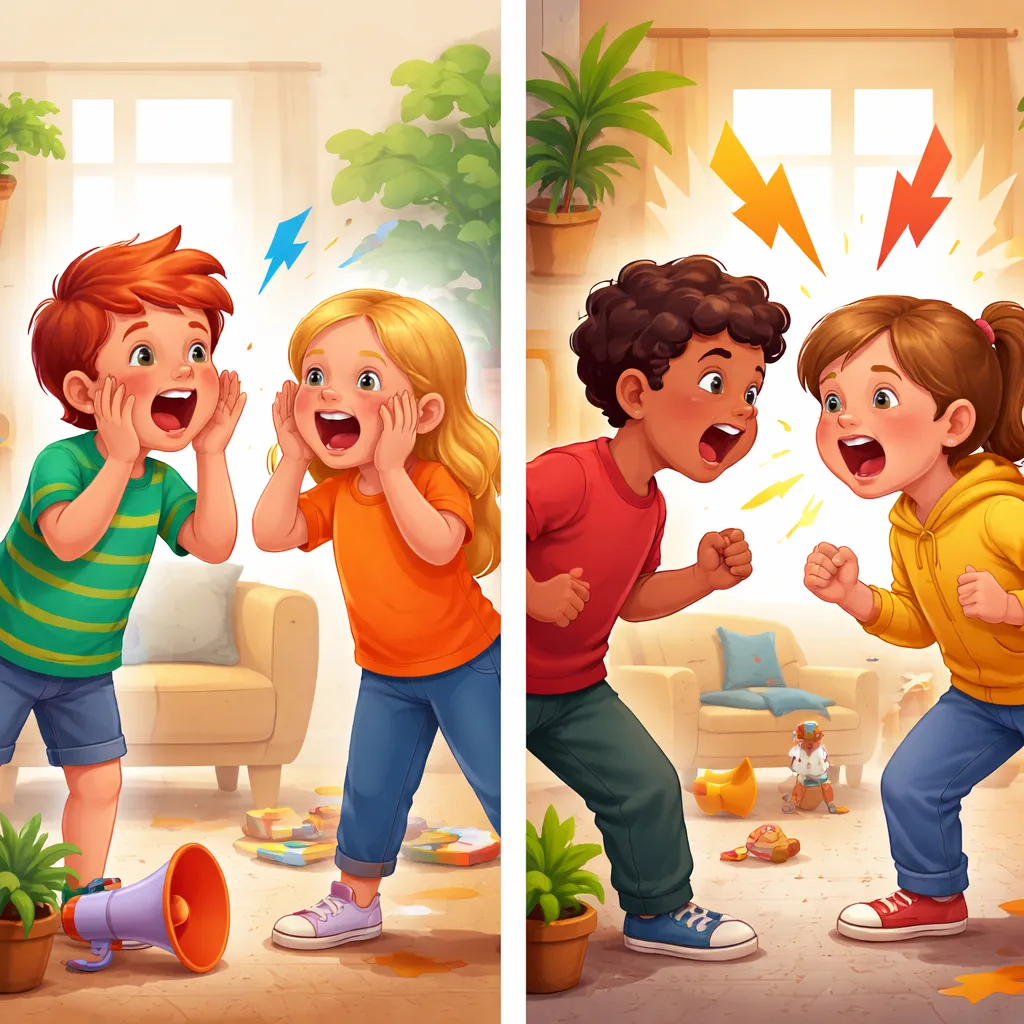

Hello, sound explorer! Have you ever had to call a friend from far away? Or felt so angry that your voice got loud? How do you talk about that? Did you shout to get their attention? Or did you yell because you were upset? They both seem to mean using a very loud voice. But are they the same? They are like two different kinds of loud. One is a big, powerful amplifier. One is a sharp, sudden siren. Let's find out! Today, we explore the word friends "shout" and "yell". Knowing their secret is a superpower. It lets you describe loud sounds perfectly. Let's start our noisy adventure!
First, let's be Volume Detectives. Listen at home. Here are two sentences. "I had to shout to my brother in the backyard so he could hear me from the kitchen." "I started to yell when I saw my little sister about to touch the hot stove!" They both talk about loud voices. Calling a brother. A warning. Do they sound the same? One feels like a big, projecting voice. One feels like a sharp, emotional burst. Can you sense it? Great observation! Now, let's listen to the loud.
Adventure! Into the World of Loud Voices
Welcome to the world of high volume! "Shout" and "yell" are two different loud-makers. Think of "shout" as a big, powerful amplifier. It makes your voice carry a long way. It is about distance and power. Think of "yell" as a sharp, sudden siren. It is about strong, often angry emotion. Both are loud. But one is for reaching. One is for reacting. Let's learn about each loud-maker.
The Powerful Amplifier vs. The Sharp Siren Think about the word "shout". "Shout" feels like an amplifier. It is the general word for speaking very loudly. You do it to be heard. You can shout with joy. Shout across the field. The crowd shouted. It is about high volume. Now, think about "yell". "Yell" feels like a siren. It is a specific kind of loud voice. It often carries anger, pain, or a very strong warning. He yelled in frustration. Don't yell at me! She yelled for help. "Shout" is the amplifier. "Yell" is the siren. One is general. The other is emotional.
Loudness for Communication vs. Loudness from Emotion Let's compare their purpose. "Shout" is often about the need to be heard. The reason can be distance, noise, or excitement. You shout over the music. You shout in a game. "Yell" is often about the emotion behind the sound. It is a loud voice from anger, fear, or extreme pain. Parents might yell when they are very worried. You yell if you stub your toe. "Shout" is for communication. "Yell" is for emotion. One is about the volume. The other is about the feeling.
Their Special Word Partners and Common Uses Words have best friends. "Shout" loves to team up with communication. Shout out. Shout for joy. Shout to someone. "Yell" teams up with conflict and sudden emotion. Yell at someone. Yell in pain. Yell out. Note: You can "shout at" someone, but that suggests anger. "Yell at" is more common for angry speaking.
Let's visit a school scene. The gym is very noisy for the pep rally. You have to shout to talk to your friend next to you. This is about loudness for communication over noise. A student accidentally drops a heavy book on their foot. They might let out a sharp yell of surprise and pain. This is a sudden, emotional sound. Using "yell" for the pep rally chat is too emotional. Using "shout" for the dropped book is okay, but "yell" better fits the sudden pain.
Now, let's go to the playground. You are playing a wide game of tag. You see your friend far away. You shout, "Over here!" This is a loud call across distance. Two friends start arguing about a game rule. Their voices get loud and angry. They begin to yell at each other. The word "shout" paints the loud call. The word "yell" paints the angry, emotional voices.
Our Little Discovery So, what did we find? "Shout" and "yell" are both about loud voices. But they are used for different reasons. "Shout" is the general word for talking or calling very loudly. It is often to be heard over distance or noise. "Yell" is a specific word for a loud cry, often from anger, pain, fear, or a very strong warning. You shout across the playground. You yell when you are very scared. Knowing this helps you describe loud moments perfectly.
Challenge! Become a Volume Word Champion
Ready for a loud test? Let's try your new skills!
"The Best Choice" Challenge Let's imagine a nature scene. A lion is the king of his territory. He lets out a deep, powerful roar. This roar is a shout to all other animals. It says, "I am here! This is my land!" This is a loud, powerful communication. A smaller animal, like a fox, gets caught in a trap. It lets out a high, sharp, painful cry. This is a yell of fear and hurt. "Shout" wins for the lion's powerful announcement. "Yell" is the champion for the fox's painful cry.
"My Sentence Show" Your turn to create! Here is your scene: At a very crowded and noisy amusement park. Can you make two sentences? Use "shout" in one. Use "yell" in the other. Try it! Here is an example: "We had to shout our conversation to hear each other over the roller coaster noise." This is loudness for communication. "Someone cut in line, and an angry man started to yell at them." This is loudness from anger. Your sentences will show two reasons for loud voices!
"Eagle Eyes" Search Look at this sentence. Can you find the word that could be better? Let's check a home context. "My mom had to yell my name three times from the kitchen before I heard her and came downstairs." Hmm. The sentence describes a mother trying to get someone's attention from another room. The word "shout" is a more common and neutral choice for this. "My mom had to shout my name three times from the kitchen before I heard her and came downstairs." Using "yell" here makes it sound like she was angry, but she might just have been trying to be heard. Did you spot it? Excellent word work!
Harvest and Action! Turn Knowledge Into Your Superpower
Great exploring! We started thinking "shout" and "yell" were the same. Now we know they are two different loud-makers. We can use the amplifier of "shout" for being heard. We can use the siren of "yell" for strong feelings. You can now talk about loud sounds with perfect accuracy. This is a great skill for telling exciting stories.
What you can learn from this article: You can now feel that "shout" is the general word for speaking with a very loud voice, usually because you need to be heard over distance or noise, or because you are very excited. You can now feel that "yell" is a more specific word for a loud, sharp cry that often comes from a strong emotion like anger, fear, pain, or a sudden warning. You know that you shout to a friend across the street, but you might yell if you are very frightened. You learned to match the word to the reason: "shout" for loud communication, "yell" for loud emotion.
Life practice application: Try your new skill today! Be a sound detective. When you hear a loud voice, ask yourself: is that a shout or a yell? Why? Next time you need to be loud, think about your word choice. Tell a story about a time you had to shout. Describe a time you heard someone yell. You are now a master of volume words! Use your powerful words wisely.