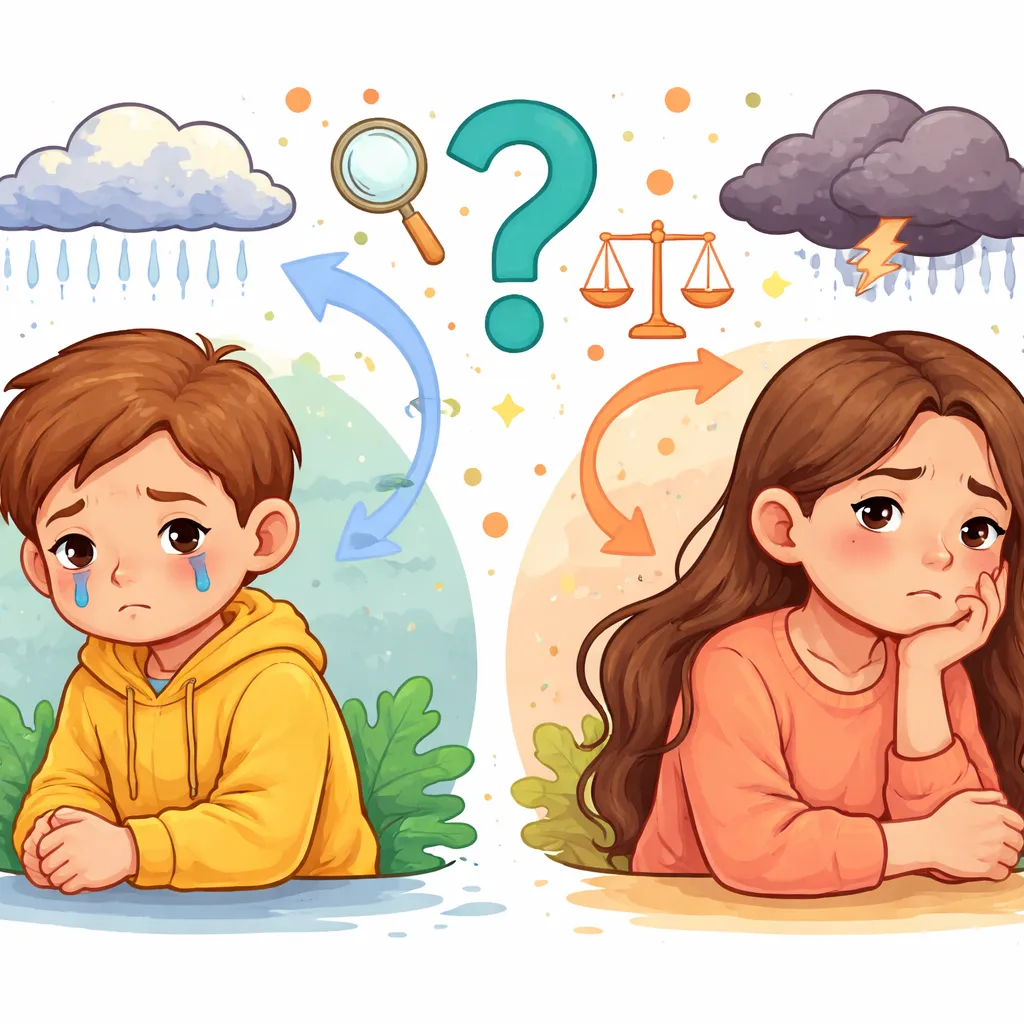

Hi there, word explorer! Have you ever felt a not-so-good feeling? Maybe your favorite game broke. Maybe your friend had to go home early. How do you describe that feeling? Do you say you feel sad? Or do you say you feel unhappy? They seem like the same thing, right? Both are the opposite of happy. But are they secret twins, or just close cousins? Knowing the tiny difference is a superpower. It lets you paint your feelings perfectly. Let's go on a feeling-word adventure today! We will discover the secrets of "sad" and "unhappy".
First, put on your detective hat. Let's be Feeling Observers. We will listen at home. Here are two sentences. "I felt sad when my goldfish died." "She was unhappy with the rainy weather." They both talk about a not-happy feeling. One is about a pet. One is about weather. Do they sound the same? Or do they feel a little different? One feels deeper. One feels more about a situation. What do you think? Great job noticing! Now, let's look much closer.
Adventure! Diving Into the Feeling Ocean
Welcome to the ocean of feelings! Today, we are diving deep. We will explore "sad" and "unhappy". They are like two different kinds of gray clouds. Let's learn about each one.
The Rainy Cloud vs. The Gray Sky Think about the word "sad". "Sad" feels like a steady, gentle rain. It is a clear emotion. It is a deep feeling inside your heart. You feel sad when you say goodbye. You feel sad when you lose something special. It is a pure emotion, like the color blue. Now, think about "unhappy". "Unhappy" feels more like a gray, cloudy sky. It is not raining yet. But the sun is not shining. It is a feeling of not being pleased or satisfied. You are unhappy with a messy room. You are unhappy with a boring movie. "Sad" is the raindrop. "Unhappy" is the cloudy day. Both are not sunny. But one is wetter and deeper.
The Deep Sigh vs. The Light Frown Now, let's listen to their volume. "Sad" is like a deep, quiet sigh. It is a heavy feeling. It can be strong and last a while. A child is sad to move schools. A story can have a sad ending. The feeling sits with you. "Unhappy" is more like a light frown. It is often milder. It is more about a moment or a situation. You are unhappy with your sandwich. You are unhappy about a changed plan. "Sad" is the deep ocean. "Unhappy" is a puddle. One is a bigger, heavier feeling. One is often a smaller complaint.
How They Like to Work in Sentences Words have favorite ways to work. "Sad" is a simple, strong word. It often stands alone. It describes the emotion itself. I am sad. He looks sad. It was a sad movie. "Unhappy" likes to have a reason. It often works with the words "about" or "with". It tells us why you are not pleased. She is unhappy with her test score. They are unhappy about the decision. You can also say "He is an unhappy person." This describes his general mood. "Sad" is the feeling. "Unhappy" is often the feeling about something.
Let's visit the school scene. Imagine you worked hard on a project. You did not win first place. You might feel very sad. This is a deep feeling of disappointment. Tears might come. Now, imagine your class has to stay inside for recess. The game is boring. You might feel unhappy. You are not pleased with the situation. Using "sad" for the boring game is possible. But "unhappy" fits the mild annoyance better. "Sad" is for the big loss. "Unhappy" is for the small inconvenience.
Now, let's go to the playground. Your best friend cannot come to play. You sit on the swing alone. You feel sad. This is a lonely, heartfelt feeling. Later, you play a game. The rules seem unfair. You feel unhappy with the rules. You are dissatisfied. The word "sad" paints the feeling of missing your friend. The word "unhappy" paints the feeling of not liking the rules.
Our Little Discovery So, what secrets did we find? "Sad" and "unhappy" are both not-happy feelings. But they are different. "Sad" is a deeper, purer emotion. It is like a rainy day in your heart. "Unhappy" is often a milder feeling of not being pleased. It is like a gray, cloudy mood. "Sad" can stand strong by itself. "Unhappy" often likes to point to a reason. Knowing this helps you share your heart just right.
Challenge! Become a Feeling Word Champion
Ready for a challenge? Let's test your new super sight!
"The Best Choice" Challenge Let's imagine a nature scene. A little rabbit loses its favorite carrot. It looks for a long time. It cannot find it. The rabbit sits quietly. It feels... what? Is it sad or unhappy? The rabbit is sad. It feels a real sense of loss. Now, imagine a squirrel. It usually finds big nuts. Today it only finds a small nut. The squirrel looks at the nut. It is not pleased. The squirrel is unhappy with its small snack. "Sad" wins for the deep feeling of loss. "Unhappy" is the champion for the mild dissatisfaction.
"My Sentence Show" Your turn to create! Here is your scene: Dinner time at home. Can you make two sentences? Use "sad" in one. Use "unhappy" in the other. Try it! Here is an example: "I was sad when my grandma left." This is a deep, heartfelt feeling. "My brother was unhappy with the vegetables." This is a mild complaint about the food. Your sentences will show different shades of a not-happy feeling!
"Eagle Eyes" Search Look at this sentence. Can you find the word that could be better? Let's check a home context. "The movie's ending was very unhappy, and it made me cry." Hmm. Endings that make you cry usually cause a deep, emotional feeling. The word "sad" is a more perfect fit here. "The movie's ending was very sad..." matches the strong emotion. "Unhappy" is better for describing a person's dissatisfaction. Did you spot it? You have amazing word detective skills!
Harvest and Action! Turn Knowledge Into Your Superpower
We did it! We started thinking "sad" and "unhappy" were twins. Now we know they are cousins. We can feel the deep rain of "sad". We can feel the gray cloud of "unhappy". You can now choose the perfect word. This is a wonderful skill. It helps you understand stories better. It helps you talk about your feelings better.
What you can learn from this article: You can now feel that "sad" is a deep, heartfelt emotion like a rainy day. You can feel that "unhappy" is often a milder feeling of not being pleased, like a gray sky. You know that saying "I am sad" shares a pure emotion. Saying "I am unhappy with something" often shares a complaint or dissatisfaction. You learned to pick the word that matches the depth of your feeling.
Life practice application: Try your new skill today. Tell a family member one thing that made you feel sad this week. Then, tell them one small thing that made you feel unhappy. Watch a cartoon. Listen for the words "sad" and "unhappy". When does a character use each one? This makes you a super listener. Keep exploring your feelings with the perfect words. You are a fantastic communicator