
Fun Introduction
Last Tuesday, Mia played with her toy cars. She compared her red car to her blue car. The red one was faster. Later, Mia contrasted the taste of apples and oranges. Apples were sweet and crunchy. Oranges were juicy and tangy. Both actions involved looking at differences. But comparing found similarities. Contrasting found differences. Mia wondered about the difference. She asked her dad. Dad smiled and explained. Comparing shows how things are alike. Contrasting shows how they are different. Let’s learn together.
Mia felt curious in her room. Sunlight streamed through the window. She held two crayons. One was thick. One was thin. She compared their colors. Both were shades of green. Then she contrasted their sizes. The thick one was for big drawings. The thin one was for details. Her dad nodded. He said comparing links things. Contrasting separates them. Mia understood now.
Word Breakdown
Core Principle
We reject boring dictionary definitions. We use pictures in your mind. We add functions and memory hooks. This helps you remember forever.
Compare To Do
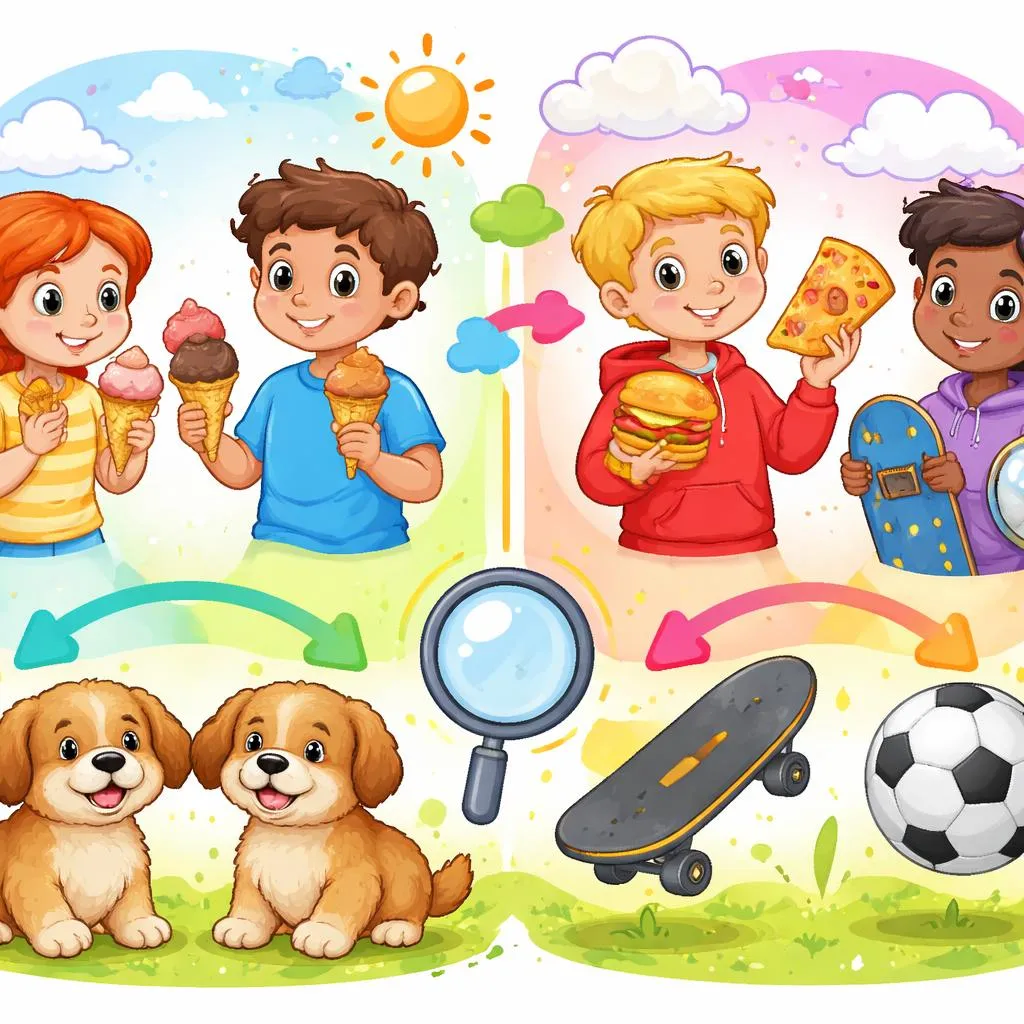
Image: Imagine comparing two ice cream cones. You see they both have chocolate sprinkles. That is compare to do. It means finding similarities.
Function: It is for showing likeness. Like compare your shoes. Or compare your scores.
Sensory Description: You see matching colors. You hear similar sounds. Your fingers feel the same texture.
Memory Anchor: Two identical toy robots. See the same shape? That is compare to do.
Contrast To Do
Image: Think of contrasting a sunny day and a rainy day. One is bright and warm. The other is gray and wet. That is contrast to do. It means finding differences.
Function: It is for highlighting unlikeness. Like contrast hot and cold. Or contrast big and small.
Sensory Description: You feel temperature change. You see opposite colors. Your ears hear quiet versus loud.
Memory Anchor: A black cat next to a white cat. See the opposite fur? That is contrast to do.
Advanced Comparison
Compare finds sameness. Contrast finds difference. Compare uses similarity. Contrast uses opposition. Use compare for alike things. Use contrast for different things.
Scene Comparison
Scene One happens in the classroom. Leo compares his drawing to his friend’s. Both show a dragon. The dragons have similar wings. This is compare to do—finding likeness.
Scene Two takes place in the kitchen. Emma contrasts apples and bananas. Apples are crisp and red. Bananas are soft and yellow. This is contrast to do—finding difference.
Scene Three occurs at the park. Ben compares two slides. Both are metal and shiny. Mia contrasts the slide heights. One is tall and fast. One is short and slow. Notice the shift. Comparing links. Contrasting separates.
Pitfalls Deep Reminder
Mistake One is saying “I contrasted my twin sisters’ hair color.” Why wrong? Twin sisters often have similar hair. Comparing is correct. Funny result? People think they have different hair. Correct phrase is I compared my twin sisters’ hair color. Memory trick: Compare similar traits.
Mistake Two is saying “I compared a cat and a dog.” Why wrong? Cat and dog are very different. Contrasting is correct. Funny result? People think they are alike. Correct phrase is I contrasted a cat and a dog. Memory trick: Contrast different animals.
Mistake Three is saying “I contrasted my two favorite shirts.” Why wrong? Favorite shirts may be similar. Comparing is correct. Funny result? You forget why you like them. Correct phrase is I compared my two favorite shirts. Memory trick: Compare liked items.
Mistake Four is saying “I compared summer and winter weather.” Why wrong? Summer and winter are opposites. Contrasting is correct. Funny result? You wear shorts in snow. Correct phrase is I contrasted summer and winter weather. Memory trick: Contrast opposite seasons.
Interactive Exercises
Read each sentence. Pick compare or contrast.
I will ___ my new shoes to my old ones. (compare/contrast)
She ___ the taste of lemon and sugar. (compare/contrast)
We ___ the size of two watermelons. (compare/contrast)
He ___ the speed of a bike and a car. (compare/contrast)
They ___ the colors of the rainbow. (compare/contrast)
Act with a friend. Use the phrases.
Scene A: Comparing Similarities
A: I need to compare these now.
B: Look for things that match.
Scene B: Contrasting Differences
A: I will contrast these items.
B: Point out what is opposite.
Spot the Mistake
Which sentence sounds odd? Explain why.
Sentence: I contrasted my two identical pencils.
Reason: Identical pencils are alike. Use compare instead.
Sentence: I compared a lion and a lamb.
Reason: Lion and lamb are different. Use contrast instead.
Sentence: I contrasted my two favorite books.
Reason: Favorite books may be similar. Use compare instead.
Create Sentences
Use both phrases.
Compare to do: I compare my test scores to my friend’s.
Contrast to do: I contrast the noise of a city and a forest.
Bonus Challenge
You have a red apple and a green apple. Do you compare or contrast? Answer: Compare. They are both apples.
Rhyme Time
Compare the same, contrast the new.
One shows alike, one shows view.
Find matches? Choose compare.
Spot differences? Contrast, it is true.
Homework Task
Pick one activity. Complete it this week. Share with family.
Option One: Observation Journal. Get a small notebook. Draw three pictures. Write a sentence under each.
Picture One: You compare something. Sentence: I compared my two toy cars.
Picture Two: You contrast something. Sentence: I contrasted a cat and a dog.
Picture Three: You compare something else. Sentence: I compared my shoes.
Show your journal to a parent. Explain the differences.
Option Two: Role Play. With a parent, act out moments. Use phrases correctly.
You: Mom, I will compare these two cups.
Parent: Tell me how they are alike.
You: Dad, I will contrast rain and sunshine.
Parent: Show me how they are different.
Practice until it feels natural.
Option Three: Sharing Time. Tomorrow at school, tell a friend. Describe one compare and one contrast. Say: Yesterday I compared my drawings. I contrasted hot and cold. Ask your friend about theirs.
Life Practice
Week Challenge: Try one task. Complete within seven days. Share your success.
Task One: Observation Log. For three days, note compare and contrast moments. Draw icons.
Day One: Compare toys. Draw a toy icon.
Day Two: Contrast weather. Draw a sun and cloud icon.
Day Three: Compare books. Draw a book icon.
Show your log to your teacher. Place it on the classroom wall.
Task Two: Action Demo. Use both phrases in real actions.
Step One: Compare carefully. Say: I compare to find what is the same.
Step Two: Contrast clearly. Say: I contrast to find what is different.
Demonstrate to a sibling. Explain the difference.
Task Three: Social Mission. Use phrases with others.
Compare to help a friend. Say: I compare your ideas to mine.
Contrast to help a friend. Say: I contrast your plan with the other.
Record a short voice message. Send it to your teacher.
Task Four: Creative Story. Write a short tale. Include both phrases.
Title: The Twin Mystery.
Story: I compared the twins’ smiles. Then I contrasted their voices. It was fun!
Share your story in class.
Remember, practice makes perfect. Use these phrases often. Soon they will feel easy.